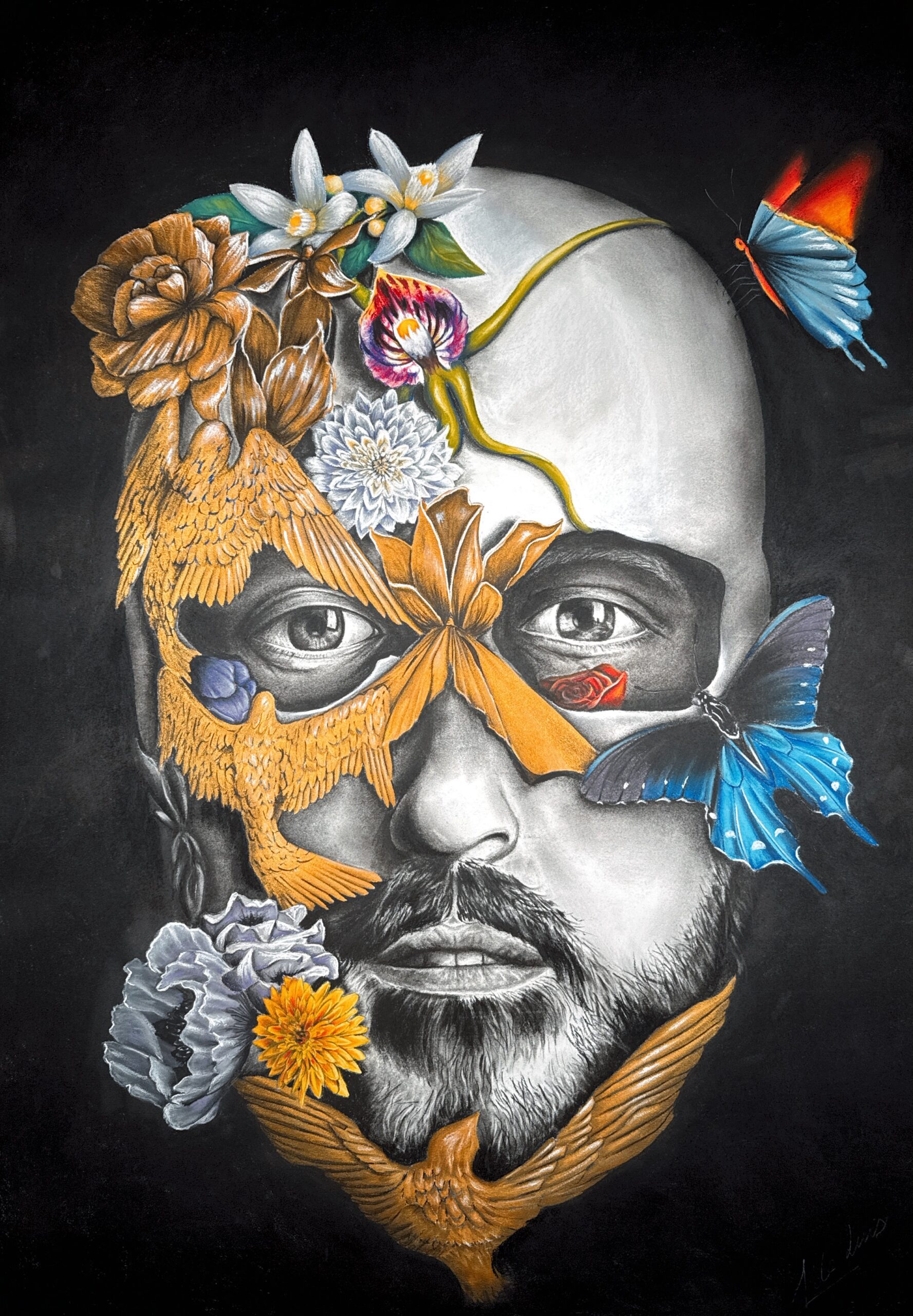
Life-death-life. Orchi series
Alexander McQueen, a romantic schizophrenic as he defined himself, was a pioneer in capturing in his creations and on the catwalk, what many called beautiful violence, a dichotomy that in a certain way refers to a balance in contrast. In his creations there was always a hint of suffering and torment, and his ability to use concepts in the creation of his collections such as ‘Jack the Ripper’, Joan of Arc, the Jacobite uprisings in the 18th century, or the Highland clearances of the 19th century, which can be seen in the collection ‘The Highland Rape’, is fascinating. To this must be added his fashion shows, with an incredible theatricality and scenography that came to resemble real movies.
This work is another homage to Alexander McQueen, for whom Jorge de Luis has always felt an undeniable fascination. It is a reinterpretation of a scene from one of his documentaries, in which he again resorts to metamorphosis: in it, Alexander's face gradually turns into a skull, covered with a framework of golden birds and flowers that later wither. The painting also features elements already common to De Luis's creations, such as the butterfly symbolizing metamorphosis and the highly symbolic floral elements in which death, life and sex mingle. Thus, we can observe the orchid, a sexual symbol, the poppy as the opium that relieves pain, the chrysanthemums present in cemeteries and the moth that refers to death, as well as the flowers of lemons, which represent bitterness.
If you are interested in this work you can contact the author using the contact form.